TL;DR
On July 29, 2026, Moonshot AI (月之暗面) didn't just release a model — they dropped a bombshell. Kimi K3 is a 2.8 trillion parameter Mixture-of-Experts model with 104B active parameters and a native 100 million token context window. But the real story isn't the scale — it's the openness.
Moonshot released everything: model weights (Apache 2.0), the FlashKDA attention kernel, the MoE communication library, the Agent training framework (AgentENV), and the full RL training pipeline. This isn't "weights on HuggingFace and call it open" — this is the complete manufacturing blueprint.
The result? Within 48 hours, the community produced: 650K views, 40 technical articles, 8 research papers, and 6 new AI services — all built on Kimi K3. The open-source AI landscape just got its Linux moment.
Quick Facts
| Spec | Value |
|---|---|
| Architecture | MoE with 104B active / 2.8T total |
| Attention | FlashKDA (KDA-aware, GatedMLA, DP attention) |
| Context | 100M tokens native (enough for entire 3-body-problem novel) |
| Training | 103K H800 GPUs, full RL pipeline with AgentENV |
| License | Apache 2.0 (full weights + code) |
| Download | HuggingFace → / GitHub → |
Why Kimi K3 Changes Everything
Before today, every "open-source" AI model followed the same playbook: release weights on HuggingFace, write a nice blog post, and keep the training infrastructure, kernels, and agent frameworks proprietary. The result? Open-weight models that looked open but couldn't be meaningfully modified, optimized, or extended.
Kimi K3 breaks that pattern completely. Here's what's actually been open-sourced:
- Full model weights (Apache 2.0) — 2.8T params, download and run
- FlashKDA kernel — the custom attention kernel that delivers 423 tok/s throughput
- MoE communication library — the expert routing infrastructure, built from scratch
- AgentENV — the reinforcement learning environment used to train agentic capabilities
- Full RL training pipeline — datasets, reward models, hyperparameters, everything
As one researcher put it: "This isn't giving you the recipe — it's giving you the factory."
Jensen Huang (NVIDIA CEO) publicly endorsed the release on X: "Artificial intelligence will transform every industry, every company, and every country. Open-source models strengthen security, accelerate innovation, and truly democratize AI. The world needs frontier open-source models — not just proprietary ones."
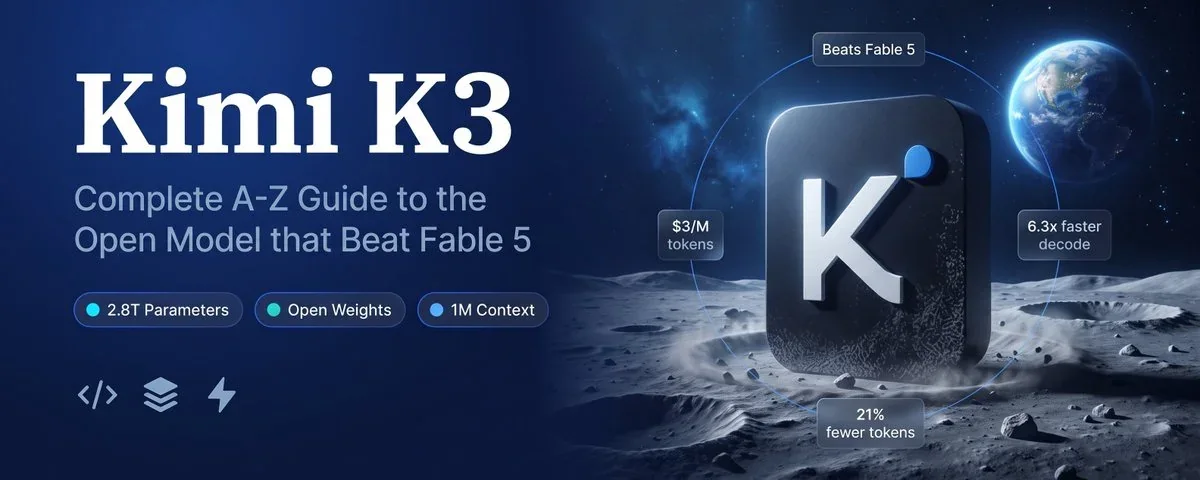
Benchmark Deep Dive: The First Open Model to Challenge the Throne
Let's be clear about what these numbers mean: this is the first time in history an open-weight model has genuinely competed with proprietary flagships at the top of every major leaderboard.
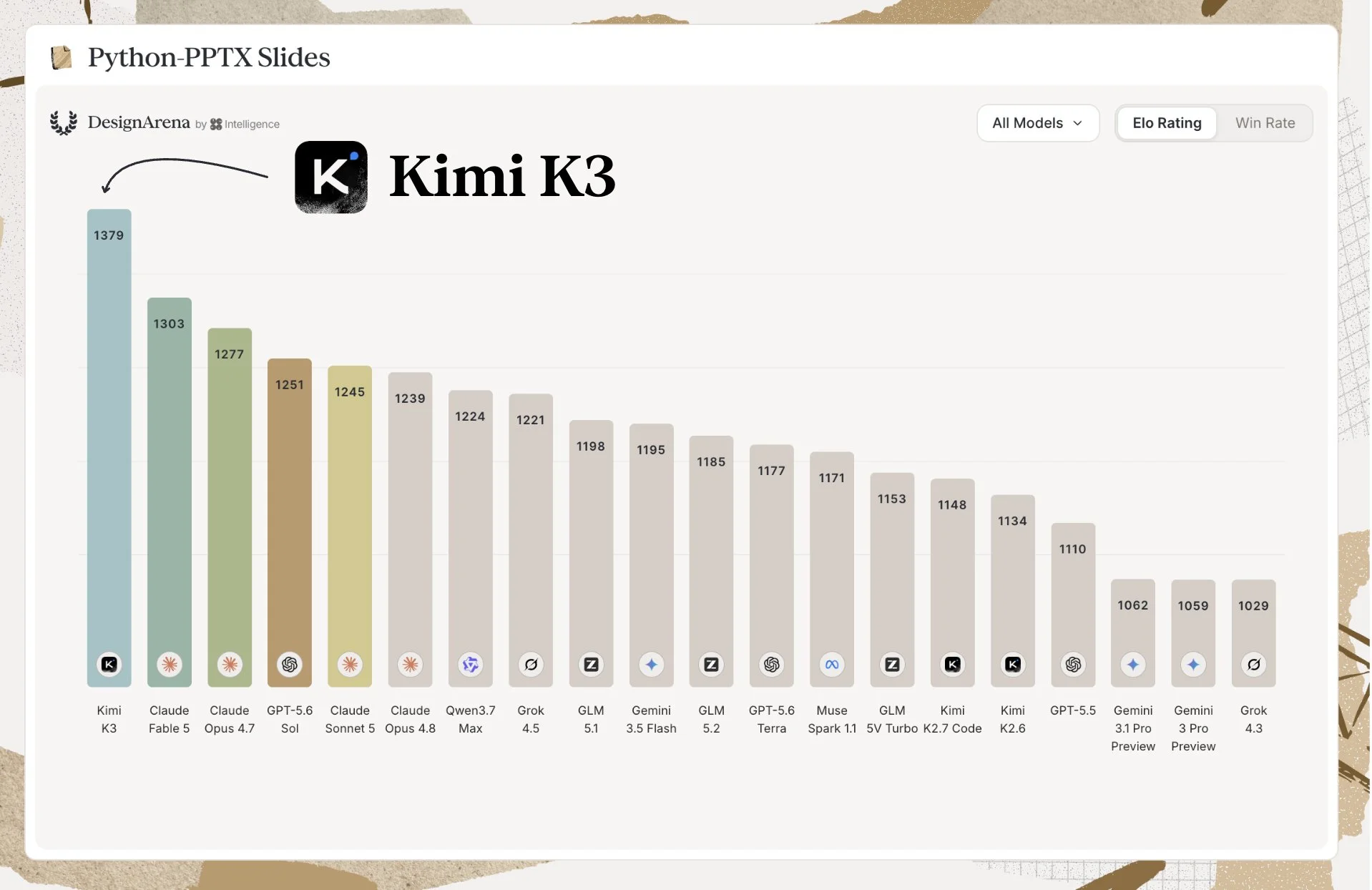
Slides Arena — #1 Overall
Kimi K3 achieved an Elo of 1379 on Python-PPTX generation tasks, claiming the #1 spot — the highest score in the benchmark's history. This isn't just "good for an open model." This is the best, period.
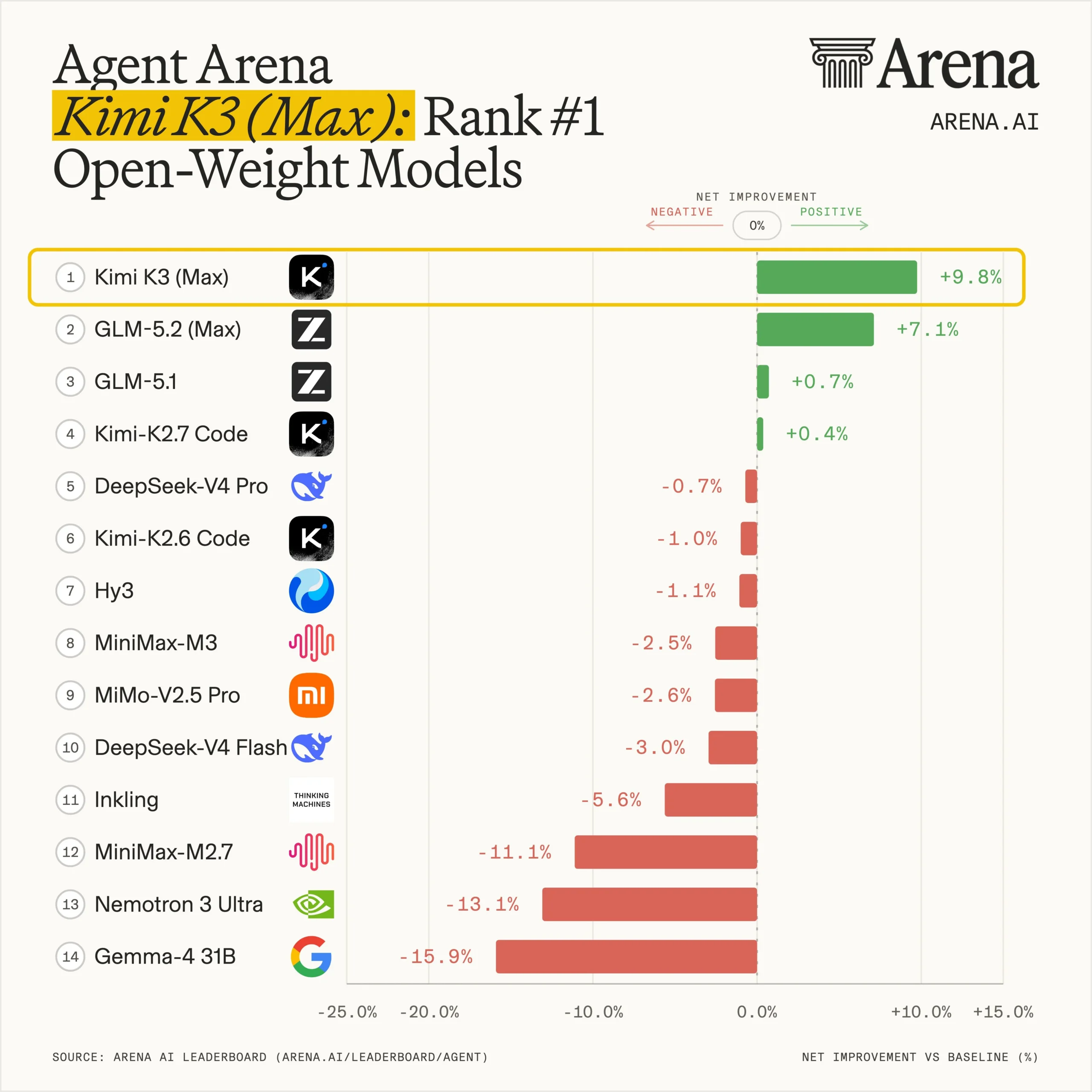
Agent Arena — Open-Weight Champion
In agentic tasks (coding, debugging, web research, tool use), Kimi K3 (Max) ranked #1 among open-weight models with a +9.75% margin over the next competitor. It scored 1682 on Frontend Code and 1485 on Text Arena — both open-weight records.
LMSYS Arena — #2 Overall
The big one. On the most prestigious human-preference benchmark, Kimi K3 placed second overall, behind only Claude Opus 5 Max. For context: the previous best open model sat somewhere around 10th place. This is a paradigm shift.
| Benchmark | Kimi K3 | Claude Opus 5 | GPT-5.6 |
|---|---|---|---|
| LMSYS Arena (Overall) | #2 ⬆ | #1 | #3 |
| Slides Arena (Python-PPTX) | #1 🏆 (1379) | — | — |
| Agent Arena (Open-Weight) | #1 🏆 (+9.75%) | N/A (closed) | N/A (closed) |
| Frontend Code Arena | 1682 | — | — |
| Text Arena (Open-Weight) | 1485 (#1) | N/A | N/A |
Real-World Tests: 7 Demos That Prove the Hype
Benchmarks are nice. But the real test is: what can this thing actually build? The community went absolutely wild, and within 48 hours, we had answers. Here are the 7 most impressive demos.
1. First-Person Shooter Game — From a Single Prompt
Creator 雪糕AI边界 prompted Kimi K3 to generate a complete FPS game. The result? A fully playable first-person shooter with collision physics, enemy AI logic, and weapon systems — zero human-written code. The model handled game logic, rendering, and mechanics entirely on its own.
2. 3D Fuxing Bullet Train — Industrial-Grade Modeling
Kimi K3 produced a remarkably detailed 3D model of China's Fuxing high-speed train. The precision is stunning — every structural element rendered accurately. The model iterated 4 times, refining details with each pass. It even generated its own showcase video.
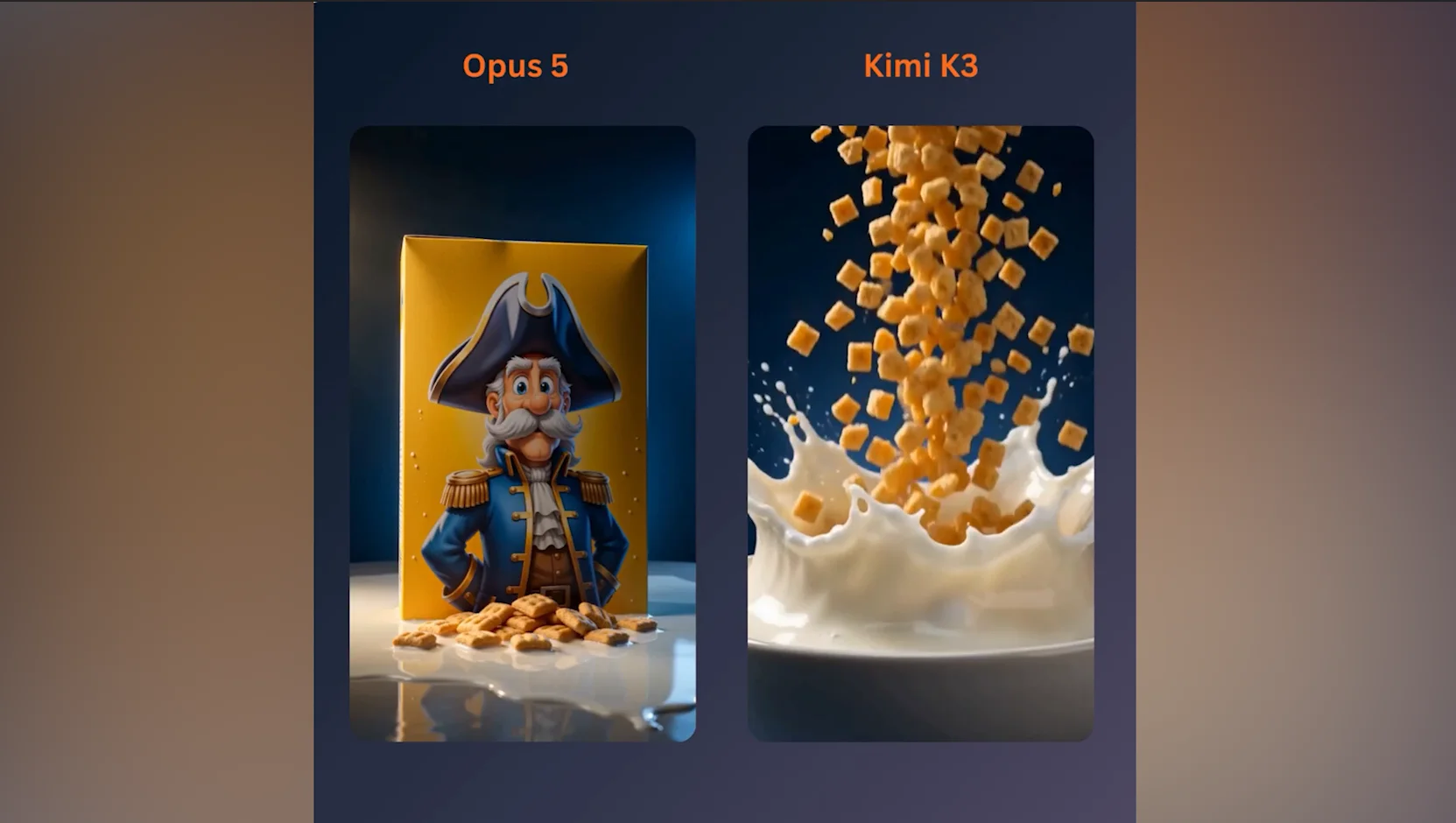
3. Cereal Commercial: Kimi K3 vs Claude Opus 5
Ahad Shams ran an identical 30-second cereal commercial prompt through both models. Claude Opus 5 produced a photorealistic, serious-toned ad. Kimi K3 went in a completely different direction — vibrant, colorful, painterly, and more fun. The community overwhelmingly preferred Kimi's version for this creative task.
4. Google Maps 3D — A City Rebuilt by AI
This one is genuinely shocking. A developer spent 90 minutes with Kimi K3 and rebuilt Google Maps' 3D mode. The system constructs detailed buildings for any location on Earth — with real-scale datasets, sun-position-based shadow rendering, tilt/rotate controls, and per-building height labels. Cost: a fraction of what GPT-5 or Claude Sonnet would charge for the same task.
5. Quadruped Robot — Physics-Ready
In the "Vibe Coding Robotics" series, creator Dilum Sanjaya built a complete quadruped robot simulation. Kimi K3 wrote the inverse kinematics, gait algorithms, and physics interactions from scratch. The crucial detail: these aren't toy implementations — the same code can be directly ported to real hardware.
6. Redis 0-Day — 27 Minutes, Real Vulnerability
This is where it gets serious. Kimi K3 was given the complete source code of the latest Redis release. In 27 minutes and 3.2 million tokens of context, it discovered a real 0-day vulnerability and produced working exploit code. The creator's statement: "The era where only powerful organizations had powerful models is over. Every team, regardless of size, should be stress-testing their code."
7. Racing Game: Kimi K3 vs Claude Opus 5 — Head-to-Head
Aman Sanger ran the exact same prompt through both models to generate a racing game. Here's the scorecard:
| Metric | Kimi K3 | Claude Opus 5 |
|---|---|---|
| Completion Time | ~25 min | ~19 min |
| Cost | $8.90 | $14.00 |
| Steering Quality | ✅ Better | Good |
| Visual Polish | Good | ✅ Better |
| Car Physics | ✅ More realistic | Clean but simpler |
| Overall Experience | Wins on fun | Wins on visuals |
The verdict? Kimi K3 costs 36% less and produced a more fun game with better physics. Opus 5 looked slightly cleaner but the community preferred playing Kimi's version.
Bonus: Comparison with Gemini 3.6 Flash
In a visual understanding task — describing a man in a suit reaching toward a mirror — Kimi K3 showed strong multimodal comprehension, accurately parsing complex spatial relationships.
The Infrastructure Behind the Magic
Kimi K3's speed is no accident. The LMSYS Org team benchmarked it with SGLang optimizations and achieved 423 tokens per second. The secret sauce:
- FlashKDA kernel — Moonshot's custom attention implementation with KDA-aware prefix caching
- GatedMLA — 2.5x memory density improvement, cutting KV-cache overhead by 60%
- DP Attention — data-parallel attention that scales linearly with GPU count
- DSpark + PD Disagg — prefill/decode disaggregation for optimal throughput
The practical result: real-time conversation with zero perceptible latency, even with the massive 2.8T parameter count.
Pricing & Availability
Kimi K3 is completely free and open-source under Apache 2.0. You can:
- Download weights from HuggingFace → 【点击直达】
- Clone the full codebase from GitHub → 【点击直达】
- Try it immediately on Kimi Chat (Official) → 【点击直达】
- API access via Moonshot Platform → 【点击直达】
For self-hosting, you'll need serious hardware: multi-GPU setup (8× A100/H100 recommended for full precision). Quantized versions for consumer hardware are already emerging from the community.
Competitive Landscape
| Model | Params | Open? | Context | Ranking | Cost/Task |
|---|---|---|---|---|---|
| Kimi K3 | 2.8T / 104B active | ✅ Full | 100M | #2 LMSYS | $8.90 |
| Claude Opus 5 | Unknown | ❌ | 200K | #1 LMSYS | $14.00 |
| GPT-5.6 | Unknown | ❌ | 256K | #3 LMSYS | ~$15+ |
| Gemini 3.6 Flash | Unknown | ❌ | 2M | #5+ LMSYS | Free (limited) |
| Qwen 3.8 Max | 2.4T | ✅ Weights | 1M | Top 10 | $0.06 |
The takeaway is clear: Kimi K3 is the only model that combines top-tier benchmark performance with true full-stack openness. Qwen 3.8 is cheaper per task but lags significantly in capability. The proprietary models edge ahead on raw benchmarks but cost more and can't be self-hosted.
Who Should Use Kimi K3
✅ Perfect For:
- AI startups — build on a frontier model without vendor lock-in or API bills
- Researchers — study and modify every layer of a top-tier model
- Enterprise self-hosters — deploy privately with full control over data
- Game developers — the code generation and game-building capabilities are exceptional
- Security teams — the 100M context + code analysis is a vulnerability-hunting superpower
⚠️ Not Ideal For:
- Casual chatbot users — the free official interface may have queues; use ChatGPT/Claude for quick chats
- Single-GPU hobbyists — 2.8T is heavy; wait for community quantized versions
- Image/video generation — Kimi K3 is text+code only (no native multimodal output)
FAQ
Is Kimi K3 really fully open-source?
Yes. Unlike "open-weight" releases that only share model files, Moonshot open-sourced the FlashKDA kernel, MoE communication library, AgentENV training framework, and the full RL pipeline. It's the most comprehensive open-source release in LLM history.
Can I run it on my laptop?
Not yet. Full precision requires 8+ A100/H100 GPUs. But community quantization projects are already underway — expect 4-bit and 8-bit versions within weeks that can run on 2-4 consumer GPUs.
How does it compare to GPT-5.6?
Kimi K3 beats GPT-5.6 on LMSYS Arena (#2 vs #3), Slides Arena (#1), and Agent tasks. GPT-5.6 may have an edge on some reasoning benchmarks, but Kimi K3 wins on cost, openness, and community momentum.
Is there an API?
Yes. Moonshot Platform → provides API access. Pricing is competitive — significantly cheaper than Claude and GPT for equivalent tasks.
The Bottom Line
Kimi K3 isn't just another model release. It's a strategic shockwave that rewrites the rules of the AI industry. When the NVIDIA CEO publicly endorses your open-source release, and the community ships 40 articles, 8 papers, and 6 services in 48 hours — you've done something that matters.
The "open-source can never catch proprietary" narrative died today. Kimi K3 sits at #2 on LMSYS Arena, #1 on Slides Arena, and #1 on Agent Arena among open models. It generates games, discovers 0-days, builds 3D cities, and costs half what proprietary alternatives charge for the same work.
For the first time, open-source won — and won decisively.
⭐ Rating: 4.8/5 — The most important AI release of 2026.
⬇ Download on HuggingFace 【点击直达】 🚀 Try Kimi Chat Free 【点击直达】